Confessions of a Traditional Media Purist
On Tony Foster and the beauty of crooked lines
By Lilah Chen

I discovered The Foster Museum in seventh grade. Tucked in an alleyway on the outskirts of Palo Alto, the tiny museum exclusively displays watercolor paintings by British plein air artist Tony Foster. My favorite way to envision Foster is in full scuba-diving garb; face-to-face with a thriving coral reef, sketching the underwater ecosystem with his special colored pencils on waterproof paper. It’s that image that has captivated me since age 12: Why not just take a picture underwater and sketch from the reference on dry land? Why go through all avoidable trouble? But it’s this “avoidable trouble” that defines Foster’s artwork. From volcanoes in Bolivia and rainforests in Costa Rica to Mount Everest and Lewis and Clark’s trail across the U.S., Foster renders his subjects exactly as they live and breathe. His paintings, the fruits of his journeys, glow with the energy of an artist awed by what his very eyes perceive. Since I first encountered the artwork of Tony Foster, I’ve been a traditional media purist.
A few months ago, I found myself unabashedly advocating for the unparalleled superiority of traditional media in artwork to a dear friend over a plate of JJ’s chicken tenders. While I’ve been involved in my own guilty little tango with digital drawing, I repeatedly find myself going back to traditional media. I’m a picky perfectionist, but I find myself unsatisfied with the signature precision and ease that digital artwork enables. The natural beauty of imperfection that Tony Foster captures with a wooden watercolor brush and minuscule paint palette vanishes on a tablet.
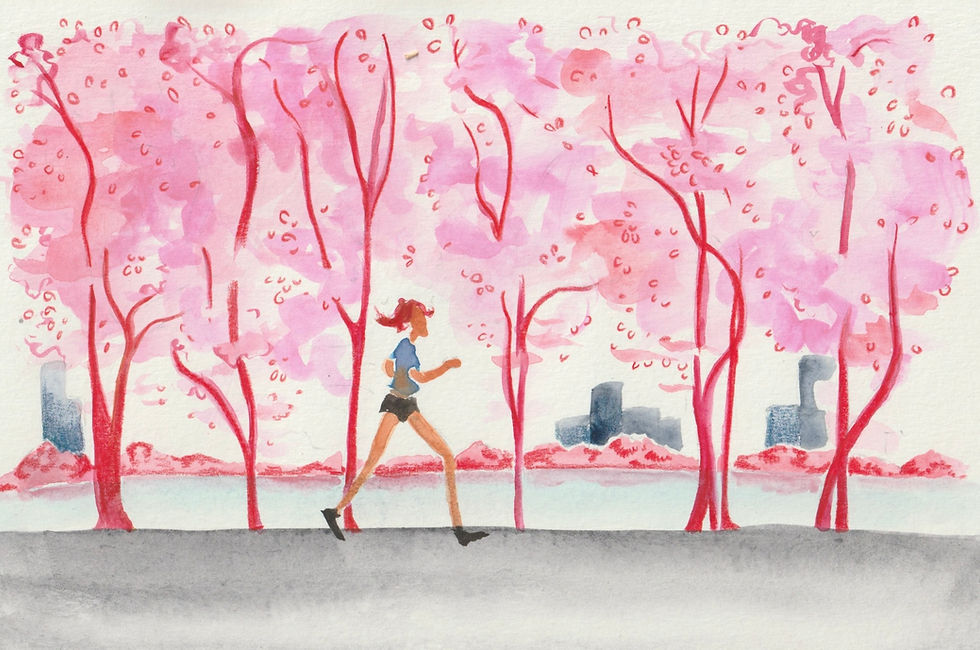
Your average childhood art teacher will console you with the classic, “there are no mistakes in art!” when you’ve painted a wayward stroke. What they really mean is that art is made of inevitable mistakes. From a toddler’s crayon scribble to a seasoned artist’s masterpiece, each work of art reflects an artist’s state of being in the world. For Tony Foster, it’s the way he sees wilderness while journeying to remote places. You draw what you know—a genuine reflection of your state of being is far more complex than a perfectly drawn shape. Each bend or notch in your crayon line is a natural byproduct of your human hand. Your art teacher wants you to stop fixating on your unavoidable human imperfection and appreciate your unique capacity to render your subject exactly as you see fit. I find that the spilled drops of paint, ink smudges and unerased pencil marks bring an artwork to life: They blanket the piece with human presence and individuality, and reveal how much beauty accompanies your mistakes.
When I illustrate for The Blue and White, I’m creating art to represent the way I see Columbia. I tend to find inspiration in Columbia’s architecture, which I love rendering in slightly imperfect ways. You can find me drawing campus doors with semi-wiggly lines and watercoloring Low Library’s facade as a somewhat decrepit ancient ruin. I design my illustrations primarily with our print copy magazines in mind, so I am always imagining how a piece will look on a 10” x 5” sheet of paper. Working with traditional media helps me connect more directly with our audience, as it allows me to see the actual paper product as I work. In my digital pieces, I find that certain details are lost upon printing, almost as if the digital-to-print pipeline has some translational discrepancies. Illustrating has pushed me to explore the tradeoffs between digital and traditional media: It is precisely because I’ve made digital art that I feel traditional media’s slow, manual approach helps me create better art.
The overwhelming, exhausting craving for perfection sinks its teeth into everyone. In the search for exactly how to achieve this standard, we can get caught up in exclusivity, novelty, and external chatter that tells us that our skills are insufficient. Whether it’s a student unhappy with a grade, a cellist frustrated with a new song, or an athlete fixating on an imperfect performance, our yearnings for flawlessness don’t make us love our work any more. I strive to draw exact shapes and straight lines, but I don’t need to achieve these to create wonderful art. My work is better, and makes the world better, when I don’t worry about showing chinks in the armor. Instead, I want to do what Tony Foster does. Go on a journey. Be inspired by my surroundings. Accept my imperfections and unapologetically permit life to influence me.