
A Dinner With Dean Sorett
What I came and left with.
By Zayna Jamil
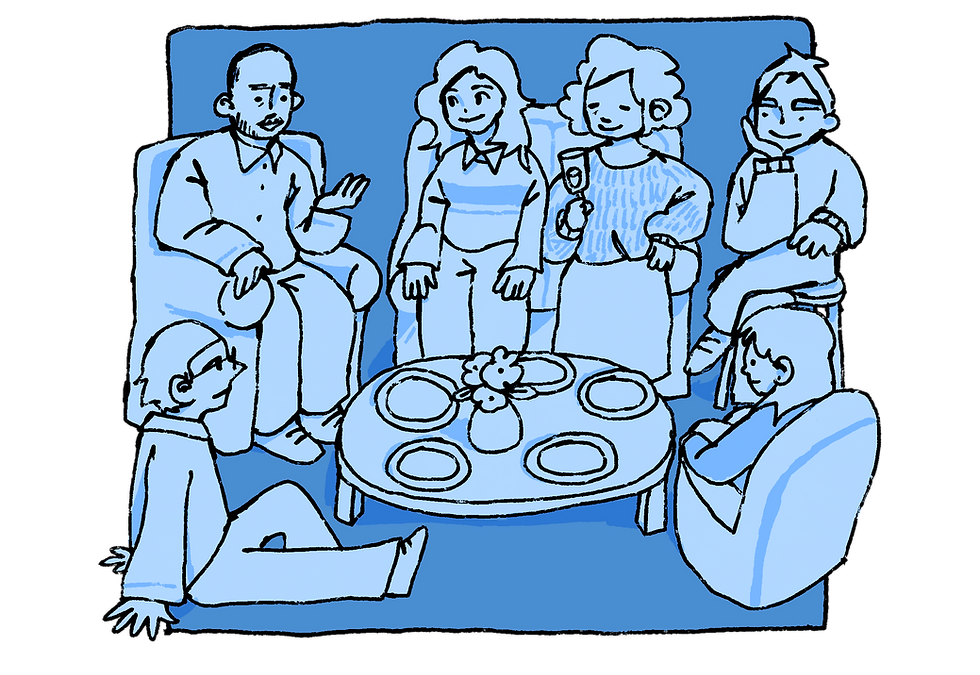
On Tuesday, March 24, I was selected via lottery to attend dinner at Columbia College Dean Josef Sorett’s apartment through the Undergraduate Community Initiative. I was among about 20 students and 15 alumni faculty members from various fields of study gathered to talk about our experiences in the College thus far.
I stepped foot into the apartment feeling a little hesitant. I searched for friends or familiar faces, but I found none. It was loud, everyone was engaged in one-on-one conversations, and dinner was being served—cutlery clattering on top of plates. Around me was modern furniture—a navy blue, grey, and white theme all throughout the kitchen and living room. As soon as I built the courage to enter an ongoing conversation, the room went quiet, and introductions began.
In a circle around the living room, we introduced ourselves: our year, major, field of study, and hometown. Gratitude expressed, accolades mentioned, and we all stayed seated. I thought we’d go right back to small talk, but instead, Dean Sorett proposed that we keep in our circle. The mood shifted.
Students started asking the faculty members questions about their relationship to the College, their personal lives, and the future of Columbia as an institution.
“Professor, what brought you to Columbia?” a student asked. “Did you know you’d end up here 20 years ago?”
“Not at all. I actually … well um … I came here because of … a girl,” he replied.
The room broke out into laughter. He went on to tell us about a girl he’d fallen in love with who encouraged him to change his life trajectory to come to Columbia. It was a story full of sincerity, proving that no matter what path you take here, there is a place for you, only if you are willing to give it a try.
One question, in particular, left us all stunned: A professor asked the students, “why, after all the campus protests, after all the media attention and government crackdowns, and after all the headlines, did you still choose Columbia?” The room went silent—all of us looked at each other with blank faces waiting for someone to answer. The audacity, I thought. But damn, what a question. I immediately felt the urge to answer.
“My purpose here, at Columbia, is defined by me and me only. I will not let headlines and the government that misconstrues student voices define it for me.”
Before I came to Columbia, many people had discouraged me from attending, citing media coverage, government involvement, and student radicalism as reasons. It was easy for people on the outside to group students into a monolith—prejudiced, heroic, reckless—but in reality, this University is far more diverse than people think: although we share similarities, we also pride ourselves in our unique lives, politics, and personalities. When I stepped foot on this campus, my purpose was to find a community, make grassroots change, and keep my family proud.
After I gave my take, the room started snapping for me. Wow, I thought. I was in a room full of people who understood me. That felt rare on a campus where there is often a stigma around certain conversations, especially those related to campus protests. I had yet to be in a setting at this school where such controversial topics were being alluded to among both students and faculty. One by one, students and professors also gave their reasoning for being at Columbia, many of which focused on aspiring to make change in the world or at the College itself.
“I have faith,” one professor said, “that no matter how hard it gets here, Columbia students are still willing to fight, not only against, but for their institution. That’s the whole point, isn’t it?”
We all sat, collectively reflecting on our belief in Columbia—what our faith meant. For many of us, faith meant possibility. All the possibilities of growth a university like Columbia could undergo if and only if students and professors continued to believe and fight for it. Witnessing everyone being equally as vulnerable as I had been was inspiring. Dean Sorett stayed quiet, letting the students and professors share rather than contributing to the conversation.
A night like this revealed to me that there are moments where I am able to speak with conviction beyond what’s encouraged, and everyone listens. It was us coming together that brought out a collective voice and reminded me of my purpose here.
When dinner came to a close, we were tying our shoes, putting on our coats, and waiting for the elevator to reach outside the apartment. It was only the professors and students now, all huddled around the elevator, smiling after a great night of fruitful conversations.
Before the dinner, I was unsure of why I was going, coming with an open mind. However, after leaving the apartment, I had a real sense of its purpose. I thought back to the question about why I chose Columbia. At that moment, all I could think about were the conversations had at dinner—between professors and students. They are the reason I chose this school. They not only keep this institution alive, but make it thrive.
I got back to my dorm just in time to start writing my essay for Lithum, bracing myself for the journey ahead of me. But instead of dreading it, I wrote with pride. Whether it be through open dialogue or passive exchanges, professors and students build a collective voice—this time, I decided to use it through writing.


